A COMPARE AND CONTRAST OF ACRYLIC VS. POLYCARBONATE IN BALLISTICS-GRADE MATERIALS
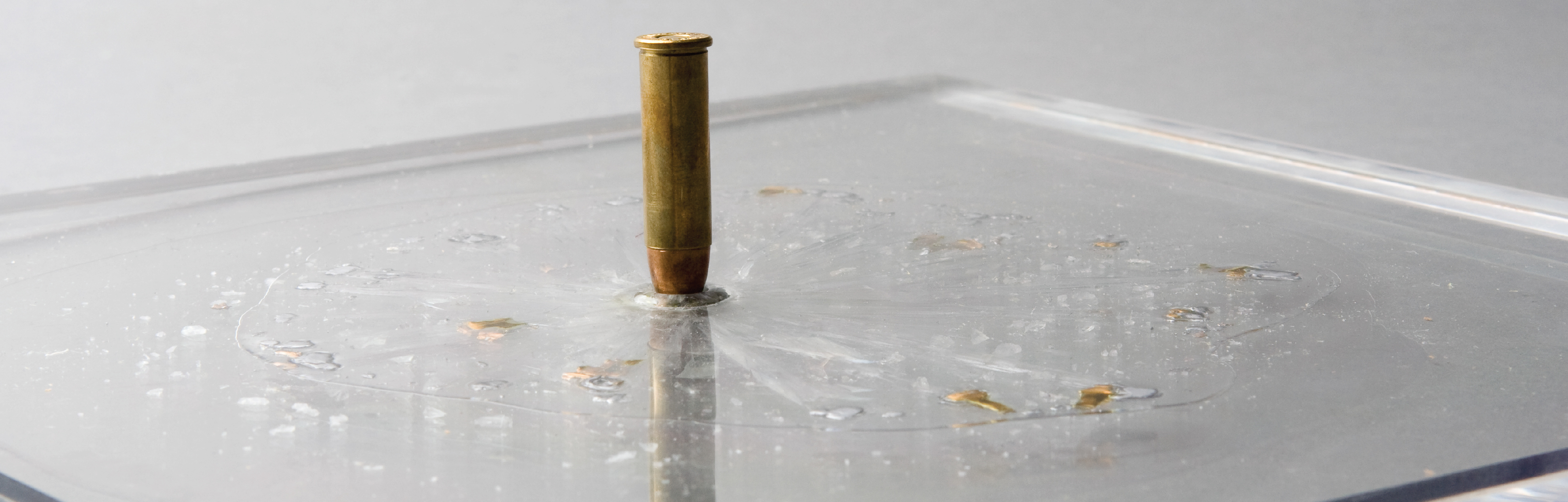
Bullet-resistant transparent materials are widely used to provide visual access while mitigating ballistic threats in architectural, transportation, and security applications. Among the most common polymer-based solutions are polycarbonate (PC) and polymethyl methacrylate (PMMA, acrylic) sheet constructions.
PLASKOLITE manufactures bullet-resistant sheet solutions using both materials, each offering distinct performance characteristics. Understanding the inherent differences between PC and PMMA enables designers, specifiers, and end users to select the most appropriate material based on threat level, durability requirements, optical performance, and lifecycle expectations.
Material Fundamentals
Polycarbonate (PC)
Polycarbonate is an amorphous thermoplastic known for its exceptional impact resistance and ductility. Under ballistic loading, PC tends to absorb energy through deformation rather than fracture, making it particularly effective in multi-hit and high-energy impact scenarios. Polycarbonate typically requires multiple layers to be bonded together in order to provide ballistic protection and high optical quality.
Polymethyl Methacrylate (PMMA)
PMMA is a rigid, transparent thermoplastic valued for its optical clarity, surface hardness, and weathering resistance. In ballistic applications, PMMA resists penetration through its stiffness and thickness, often fracturing in a controlled manner that dissipates energy. PMMA can be cast in very thick gauges which can achieve ballistic rated performance.
Key Performance Characteristic
| Attribute | Polycarbonate (PC) | PMMA (Acrylic) |
|---|---|---|
| Ballistic Energy Absorption | High energy absorption through plastic deformation | Energy dissipation through rigidity and controlled fracture |
| Impact Behavior | Ductile; resists shattering | Rigid; may crack or craze under impact |
| Multi-Hit Capability | Excellent | Good, dependent on thickness and construction |
| Optical Clarity | Very good | Excellent (glass-like transparency) |
| Surface Hardness | Moderate | High |
| Scratch Resistance | Lower without coatings | Higher inherent scratch resistance and is available with a hard coat |
| Weathering / UV Stability | Requires UV stabilization or coatings | Excellent natural UV resistance |
| Weight (per thickness) | Lower density, lighter constructions possible | Slightly heavier for equivalent ballistic rating |
| Aesthetics | Machined edge, framing systems | Ability to retain a polished edge for frameless designs |
Ballistic System Design Considerations
Bullet-resistant glazing systems often rely on laminated or layered constructions, where PC and PMMA may be used independently or in combination with other materials such as glass or interlayers.
PC-based systems emphasize energy absorption and spall control, often placed on the strike-side or safe-side depending on system design. Extreme ballistics threats combine glass and PC for optimal protection. PC is difficult to polish, and ballistic systems typically use a framing structure to hide the machined edges.
PMMA-based systems emphasize optical performance, rigidity, and surface durability, frequently used where long-term clarity and abrasion resistance are critical. Acrylic can also be easily polished to produce a clean, smooth edge. This is especially useful in customer-facing applications where softer aesthetics are preferred.
Neither approach is inherently superior; rather, each aligns with different threat profiles and service environments.
Application Suitability for Polycarbonate (PC):
- Transaction windows and teller barriers
- Mobile and transportable armor systems
- Detention and correctional facilities
- Environments with high risk of repeated impacts
- Applications requiring lightweight or formed components
- Military and Government applications for high threat protection
- Heavy equipment to protect operators from projectiles and falling objects
Key driver: High impact resistance and multi-hit durability.
Application Well-Suited for PMMA:
- Fixed architectural glazing
- Security windows with high optical demands
- Outdoor installations with prolonged UV exposure
- Retail, museum, or public-facing security barriers
- Applications where surface hardness and appearance retention are priorities
Key driver: Optical clarity, weathering resistance, and surface durability.
Summary Perspective
Polycarbonate and PMMA bullet-resistant sheets represent complementary solutions, not competing compromises.
PC provides toughness, resilience, and impact tolerance, whereas PMMA provides clarity, rigidity, and long-term environmental stability.
Material selection should be driven by threat level, environment, expected service life, maintenance requirements, and system design goals. PLASKOLITE’s capability to manufacture bullet-resistant sheet solutions in both PC and PMMA allows customers to optimize performance for each specific application rather than forcing a one-material approach.